Bergen in November: A Grey Softbox and Changing Light
In mid-November I spent a few days in Bergen. If you have been around here, you know that it is one of the rainiest cities in Norway — maybe even in all of Europe. Most of the time the sky worked like a huge grey softbox and washed everything out. Luckily, the weather here is as changeable as it is rainy, and in this post I want to show a few photos that were born from this duality.
Arrival — the first break in the clouds
Locations: Bergen felett
The duality started before we even landed. The plane came in low over the coast, through a thin layer of cloud, and for a few minutes the sun broke through right in front of us. Below us hundreds of small islands floated in the haze.
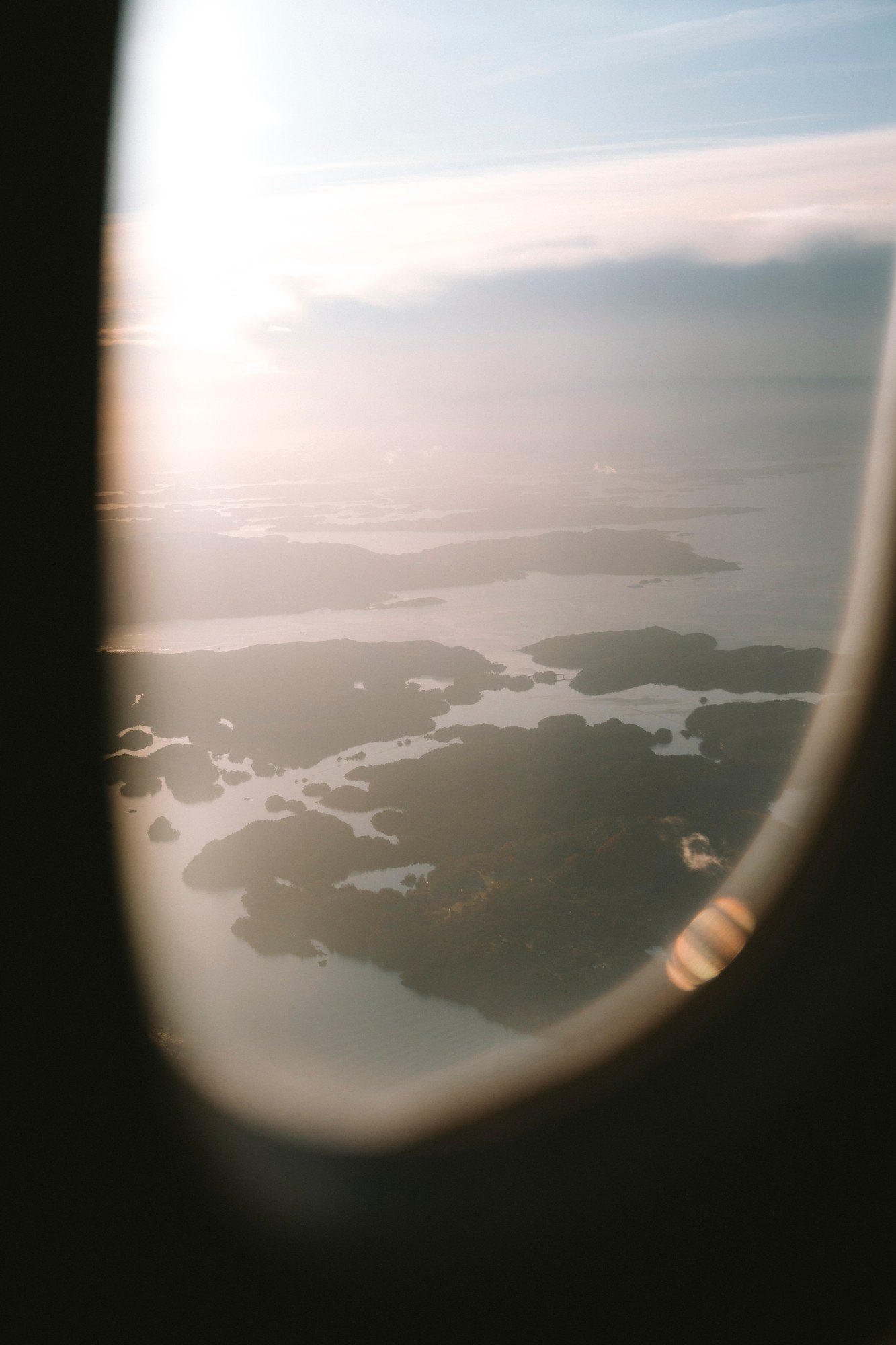
- Sony A7 IV · FE 24–105mm F4 G OSS at 54 mm
- f/4 · 1/5000 s · ISO 200
I left the window in the picture on purpose. The dark cabin wall takes up almost a third of the frame and pushes the bright landscape into the upper right corner, while the islands run diagonally from the bottom left towards the light. The whole image is one long gradient, from the burnt-out sun to the almost black cabin. The haze takes away the contrast, so the islands become soft, layered silhouettes — and I didn't try to bring it back in the edit. The colours stay muted, warm grey-brown; the only temperature contrast is the peachy glow around the sun against the cool blue sky in the corner. The orange ring at the bottom is a reflection on the window, a small warm echo of the sun.
Gullfjellet — inside the softbox
Locations: Gullbotn, Gullfjellet
The next day showed the other side. I wanted to climb Gullfjellet from Gullbotn, but the trail was much snowier than expected, and on a marsh a storm caught us with wind and hail. After 6 kilometres and 300 metres of climbing, soaked to the skin, we turned back. Just before that, we reached this small lake — and the light there was the exact opposite of the day before: no sun, no direction, no shadows. Pure softbox.
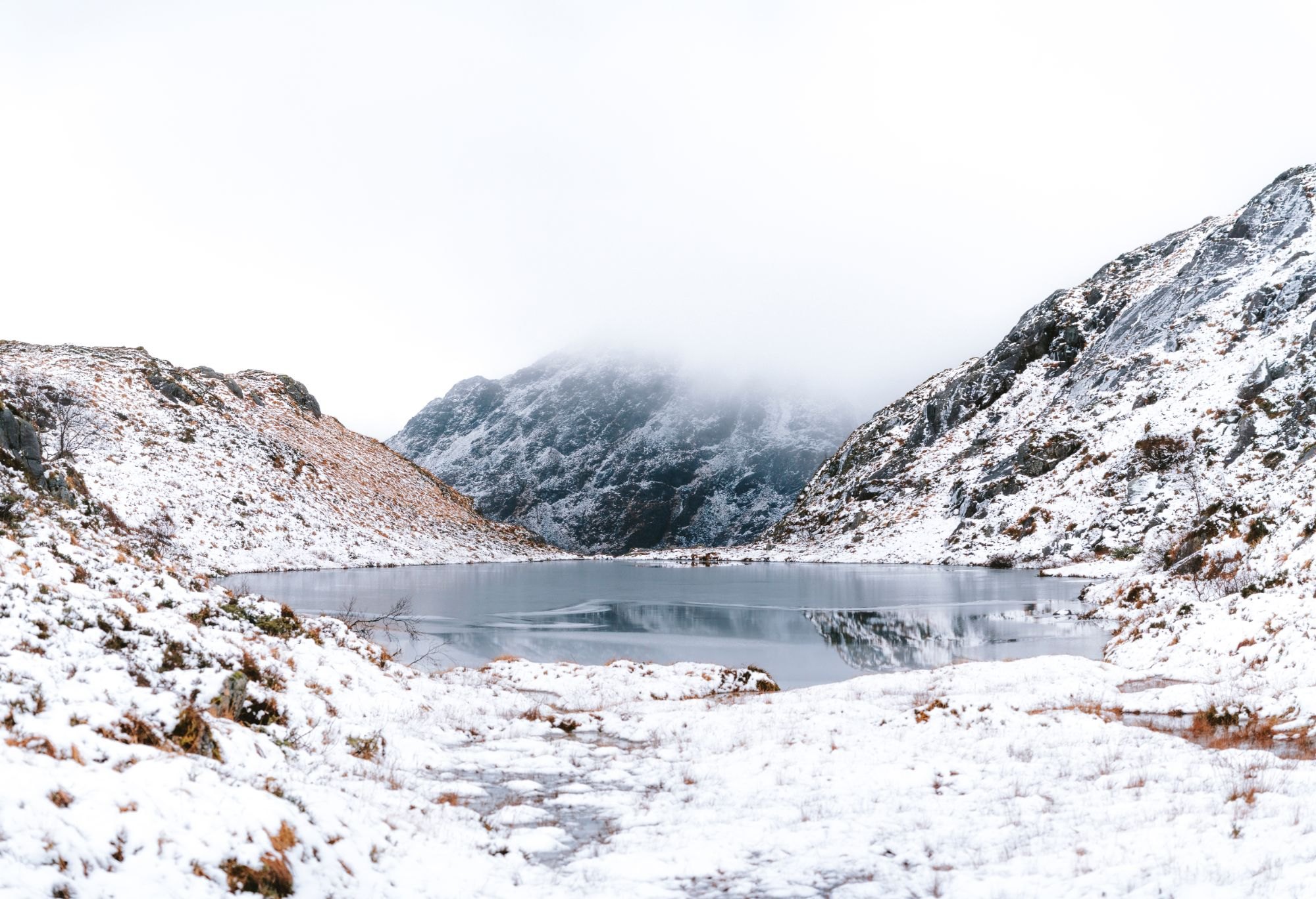
In light like this, nothing gives shape by itself, so the composition has to do it. The two slopes form a funnel that runs down to the dark mountain in the middle — the only large dark area in the picture, the anchor everything points to. The lake is a calm horizontal band across the centre, and the path in the snow leads you in from the bottom. I didn't fight the white sky. I let it melt into the snow, so the picture has no hard top edge and the cloud simply swallows the mountain. Everything is cool grey and white, and the only warm notes are the rusty tufts of dry grass on the slopes. They are tiny, but without them the image would be completely cold.
Ulriken — one warm dot
Locations: Ulriken (643 m)
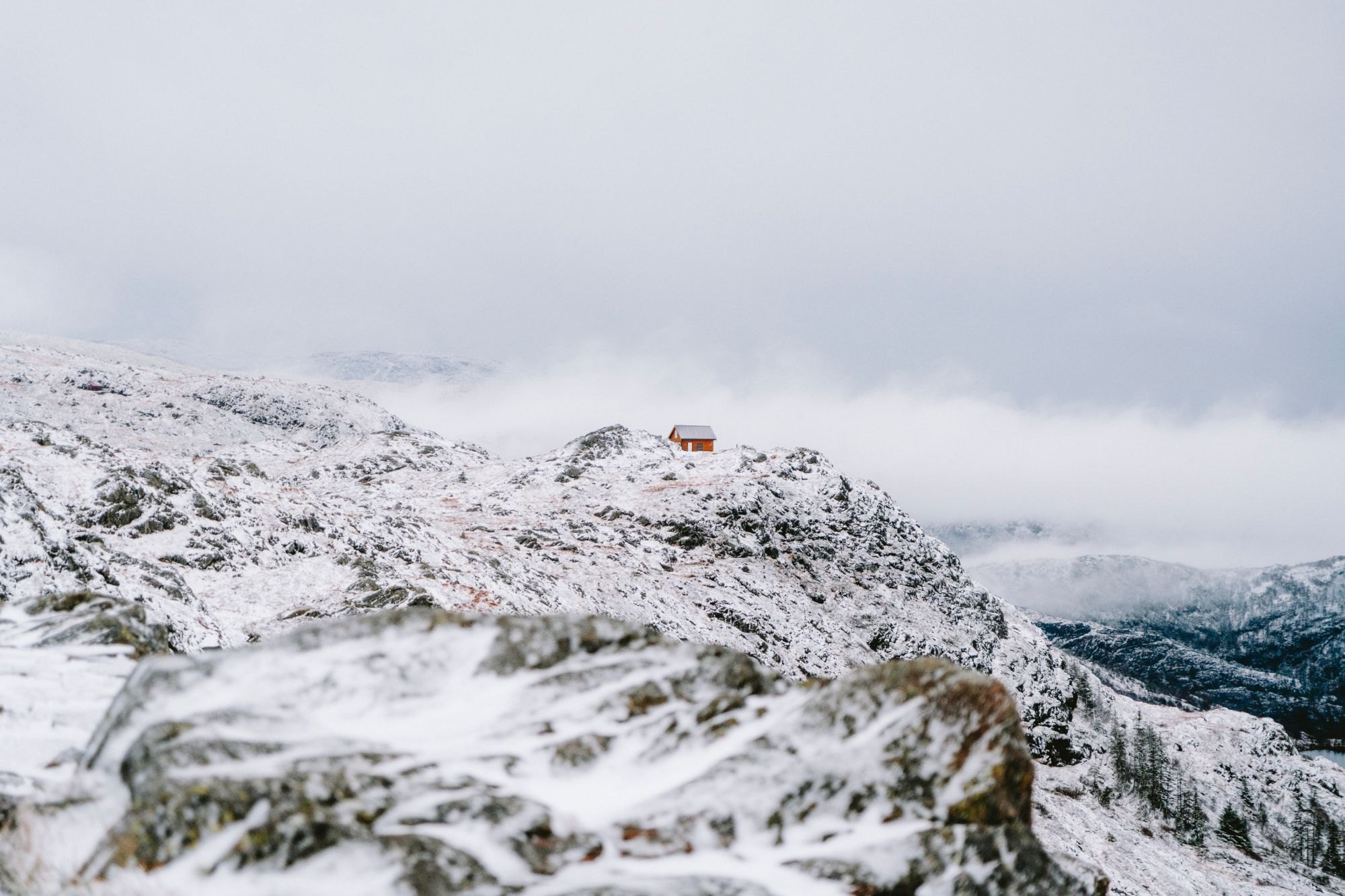
That evening we dried our shoes, and the next day we took the cable car up Ulriken, the highest of Bergen's seven mountains. Down in the city it was raining, halfway up the rain turned into snow, and at the top the clouds were drifting through the valleys below us.
This is the photo that taught me the most about the grey softbox. When the whole world is cool blue-grey, one warm colour is enough — and here it is a hut no bigger than a fingernail. It sits exactly where the ridge meets the band of cloud, with nothing around it but empty grey, so your eye finds it in a fraction of a second. The empty space is what makes the small subject strong, and it also shows how big the mountain is. The picture is built from layers: the out-of-focus rock in front, as if you were peeking over it, then the sharp ridge, the cloud and the sky. The dark blue valley on the right is a quiet counterweight to the hut.
The white house — colour in the rain
Locations: Bergen belváros
In the afternoon we walked down to the streets behind the centre, where the wooden and plastered houses stand in every colour. Bergen's houses are almost a response to the weather: when the sky is grey for months, people paint their walls red, yellow and blue. By four o'clock it was getting dark, and the cobblestones were wet.
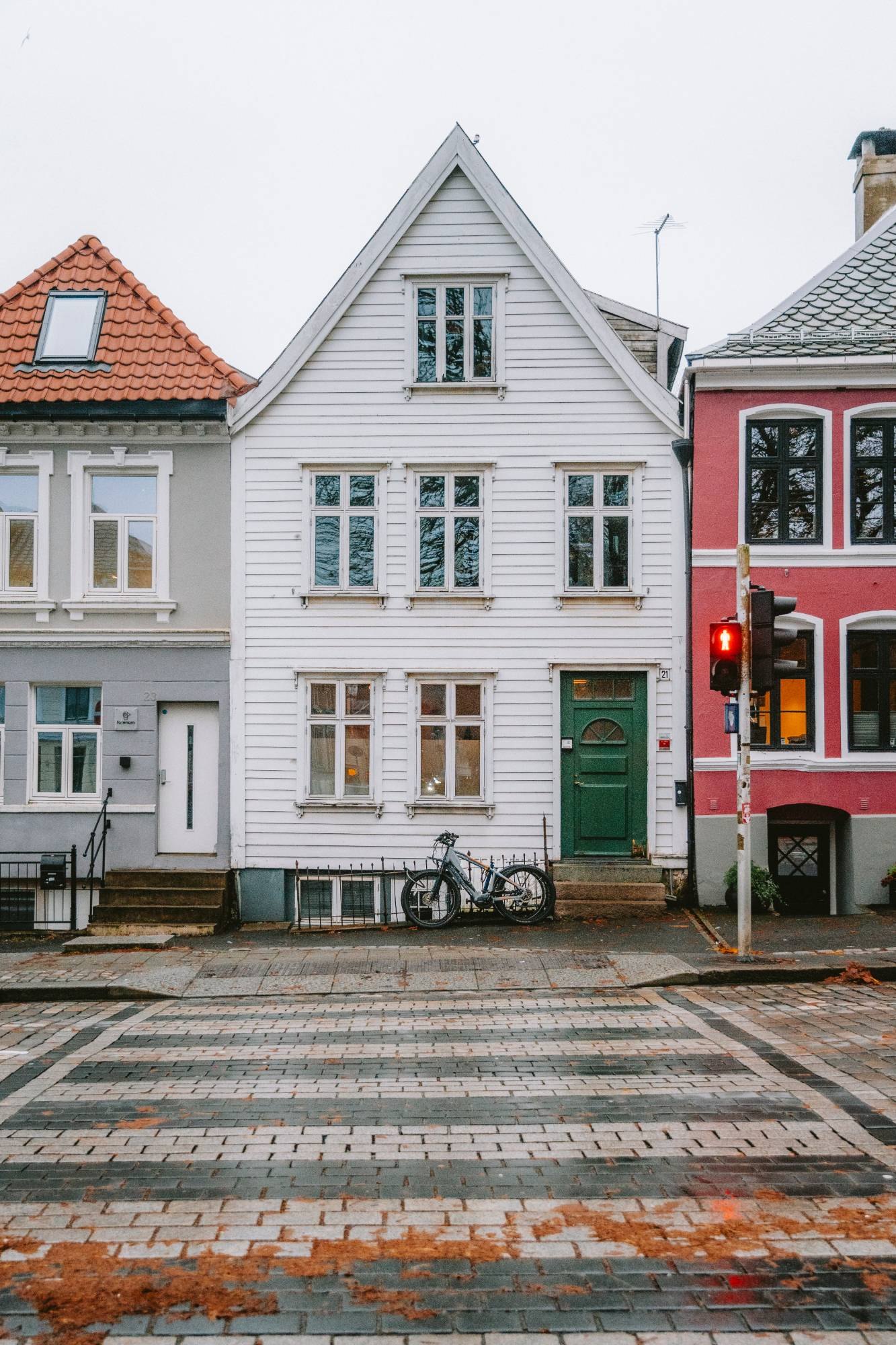
- Sony A7 IV · FE 24–105mm F4 G OSS at 34 mm
- f/4 · 1/1000 s · ISO 3200
Here the softbox works in my favour: the even light shows every colour honestly, without hard shadows. I shot the house straight on with the camera level, so the verticals stay vertical, and the picture is built from horizontal lines — siding boards, rows of windows, steps and the stripes of the crossing. The paving in the bottom third is pure graphic pattern that leads you up to the door. The centre is neutral white, framed by a cool grey house on the left and a red one on the right. The accents do the rest: the green door and the red pedestrian light are complementary colours, and together with the orange roof tiles and the fallen leaves they form a warm triangle around the white house.
The flight home — when the weather turns
Locations: Norvégia felett
And then, on the last day, the weather turned. After days of grey, the sky cleared, and we flew home at sunset. From the plane I watched the last light catch only the highest snowy ridges, while the valleys were already in deep shadow. It was the exact opposite of the softbox: hard, low, directional light — and suddenly colour everywhere.
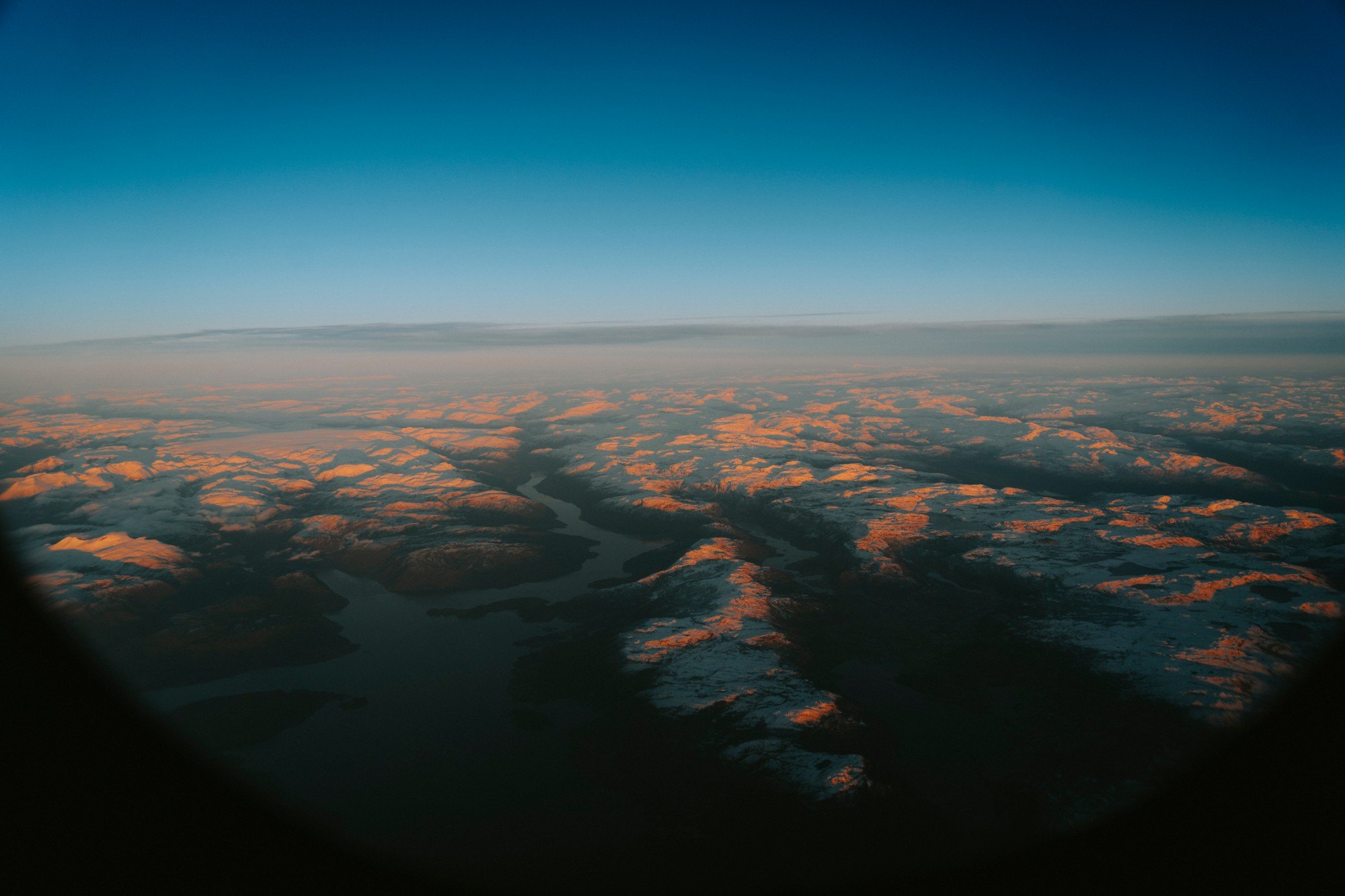
In the first frame I kept the horizon in the upper third, with a clean gradient from deep blue to pale turquoise above it. The dark fjord winds like an S-curve from the bottom left into the centre and leads the eye across the landscape, and the dark edges of the window close the picture like a vignette. The colours are the purest pair of the whole trip: blue and orange. The cold sky and the shadowed snow make the small orange spots on the peaks glow even brighter.
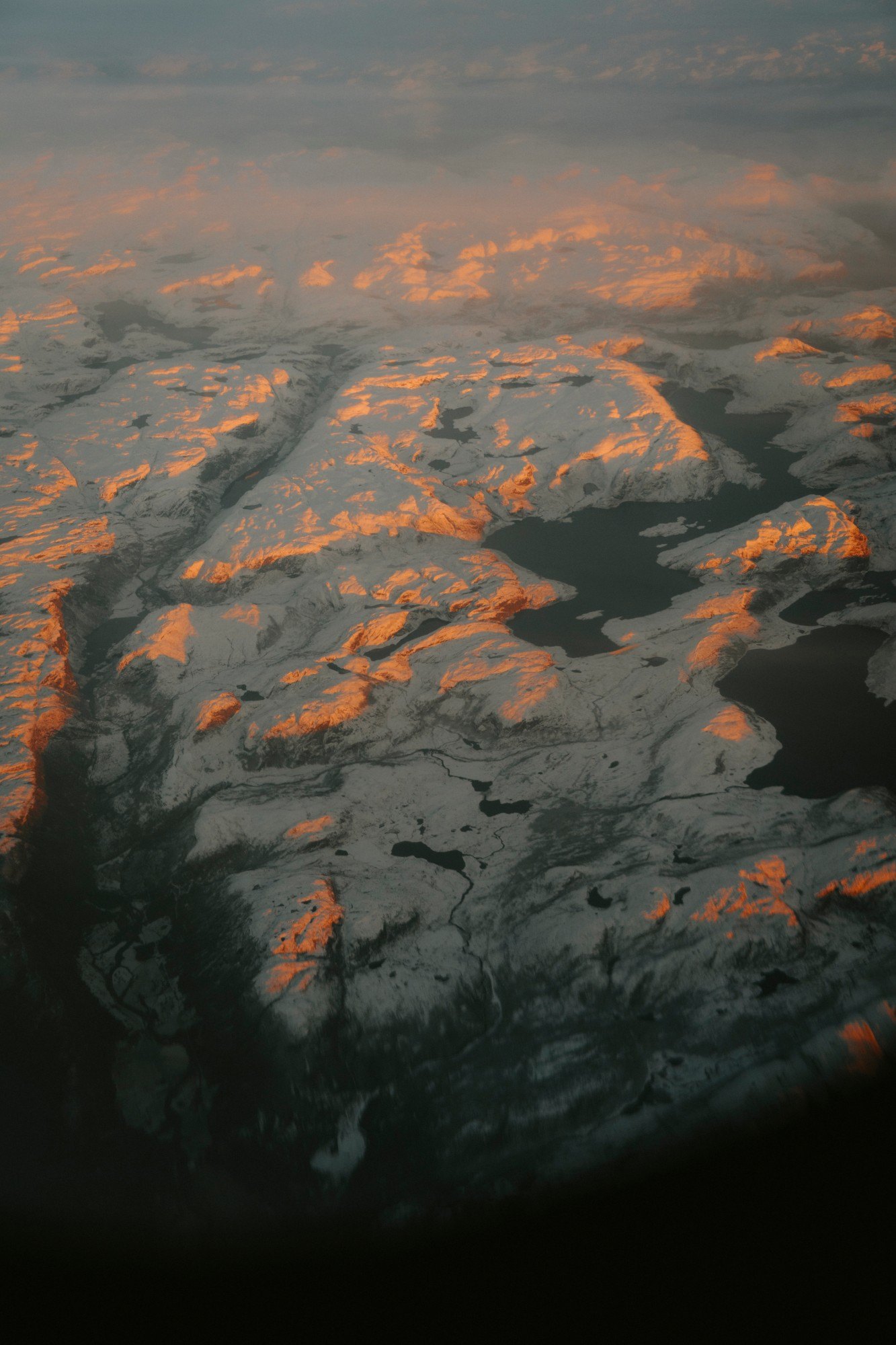
- Sony A7 IV · FE 24–105mm F4 G OSS at 49 mm
- f/4 · 1/800 s · ISO 320
A few minutes later I pointed the camera down and left out the horizon. Without a horizon there is no scale, and the landscape becomes almost abstract: ridges, lakes, lines. This picture closes the circle. On the grey days the flat light hid every shape; here the low side light draws the relief by itself, lighting only the slopes that face the sun. The palette shrinks to orange and grey-green, the haze at the top and the shadow of the wing at the bottom fade the picture out, and the orange glow in the middle carries everything.
What to watch for
- Grey light is not bad light, it is soft light. It does not give shape, so the shape has to come from the composition: lines, layers and repetition.
- In a grey scene, look for a single warm colour. A red hut, a tuft of rusty grass or a red traffic light can carry the whole picture.
- If the sky is white anyway, don't try to rescue it — let it melt into the snow or the fog, and go for a bright, high-key image.
- When the weather changes, the light changes with it. Check your shutter speed and ISO every time, so you don't shoot a still street at 1/1000 s and high ISO.
- Stay out a little longer. In Bergen the weather can turn in minutes, and the best light often comes right after the rain or in the last minutes of the day.
- On the plane, press the lens hood against the window: it cuts the reflections, and the dark frame of the window can even become part of the picture.